


Introduction
A prototype PCB assembly can be built correctly and still be hard to verify.
That is where many projects lose time. The board powers up. The placement looks fine. The solder joints pass visual inspection. Then the engineering team starts testing and discovers that key signals are buried, test pads are too small, the programming interface is awkward to reach, or the only way to debug the board is through risky bench-side probing.
That is why test access should be reviewed before prototype PCB assembly, not after the boards arrive.
Test access review checks whether the assembled board can be inspected, probed, programmed, functionally tested, debugged, and prepared for later ICT or FCT planning. It is not only a testing issue. It sits between PCB design, prototype assembly, and verification planning.
A working prototype is useful only if the team can verify what is happening on the board. Poor test access turns prototype verification into guesswork.
What Test Access Means in Prototype PCB Assembly
Test access means the practical ability to reach, control, and observe the points needed for inspection, measurement, programming, fault isolation, and functional validation.
In real PCBA work, test access may include:
- test pads for key nets
- accessible voltage rails and ground points
- programming headers or pads
- reset, clock, boot-mode, and communication access
- probe-friendly locations for important signals
- enough probe clearance around test points
- access for bench debug, flying probe, ICT, FCT, or boundary scan
- space for fixture pins, cables, clamps, or connectors
- AOI visibility for solder joints and component orientation
- X-Ray Inspection planning for BGA, QFN, or hidden solder joints where needed
A design may look complete in CAD but still be difficult to test after assembly.
This is especially common when the layout is compact, the board has fine-pitch SMT components, both sides are densely populated, or the mechanical envelope is already tight. The circuit may be electrically sound, but if the team cannot safely and repeatedly reach the right signals, verification slows down.
For prototype PCB assembly, test access is not only about future mass production. It is about answering early engineering questions without damaging the board, guessing at symptoms, or waiting for another layout revision.
Why Test Access Should Be Reviewed Before the Build
The easiest time to fix test access is before the PCB is fabricated and assembled.
Once the boards are built, the options become limited. The team can solder temporary wires, scrape solder mask, probe component pins, or create a workaround. Sometimes that is acceptable for a first engineering sample. But if every important measurement requires a workaround, the prototype is not giving clean feedback.
A simple rule helps here:
If a signal is important enough to debug, program, verify, or use for acceptance testing, the team should ask how it will be accessed before the prototype build starts.
That does not mean every net needs a dedicated test pad. Real boards have space limits. But key power rails, programming lines, communication buses, reset lines, control signals, and product-specific measurement points should be reviewed deliberately.
Waiting until prototype verification to discover poor access usually creates three problems.
First, the test process becomes slower and less repeatable.
Second, failures become harder to isolate.
Third, the team may mistake a test-access problem for a design, assembly, component, or firmware problem.
That is where a prototype build loses time.
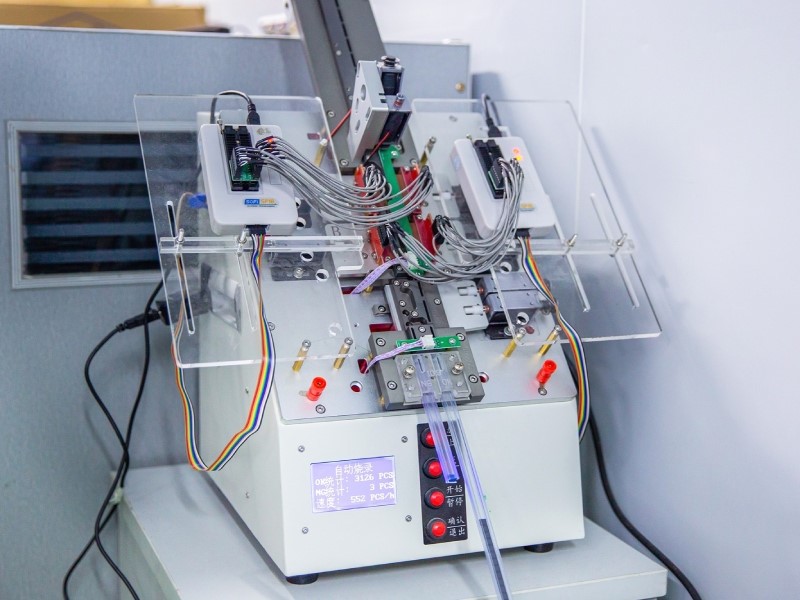
Where Poor Test Access Usually Shows Up
Test access problems rarely announce themselves in the Gerber review. They usually show up later, when the first assembled board is on the bench and someone needs to find a signal quickly.
Power Rails Are Hard to Measure
Prototype verification often starts with power.
If the main input, regulated rails, ground reference, enable pins, or current-sense nodes are hard to access, even a basic bring-up can become clumsy. The engineer may know what to check, but the board does not provide a safe place to check it.
A board that needs repeated probing on tiny IC pins during bring-up is not test-friendly. It may still work, but the risk of slipping, shorting pins, or damaging parts goes up.
Programming and Debug Interfaces Are Not Practical
A prototype may need firmware loading, bootloader access, calibration, or debug communication.
If the programming pads are too small, covered by nearby parts, placed under a shield, or blocked by a future enclosure feature, the problem may not appear until the board is already built.
This is a common mismatch between layout decisions and real prototype handling. The layout saves space, but the firmware team loses access.
Important Signals Are Buried
Some signals only become important when something goes wrong.
Clock, reset, communication, sensor, motor control, LED drive, battery management, RF enable, relay control, and safety-related signals may not need constant measurement. But if the prototype fails, these are often the first nets engineers want to check.
If those signals are not accessible, fault isolation slows down. The team may spend hours debating whether the issue is firmware, PCB assembly, component sourcing, soldering, or design logic.
Test Pads Exist but Cannot Be Used
A pad is not useful just because it exists.
It may be too close to a tall component. It may be under a connector. It may sit on the wrong side for the intended fixture. It may be too small for reliable probing. It may lack surrounding clearance. It may be placed where a probe cannot land without touching another net.
This is why test access review should look at the assembled-board condition, not only the schematic.
Test Access Is Not the Same for Every Test Method
One reason buyers overlook test access is that the word "testing" sounds like one activity.
It is not.
Different verification methods need different types of access.
Bench Debug Access
Bench debug is common in early prototypes. Engineers may use a multimeter, oscilloscope, logic analyzer, current probe, or programming tool.
For this stage, test points should support safe and repeatable measurements. Good access does not need to be perfect, but it should reduce risky probing on fine-pitch pins whenever possible.
For early prototype PCB assembly, this is often the most immediate test-access need.
Flying Probe Access
Flying probe testing can be useful for prototypes and low-volume PCB assembly because it does not require a dedicated bed-of-nails fixture. But it still needs accessible probe locations, enough spacing, usable CAD data, clear net information, and agreed test targets.
If the layout leaves too few accessible nodes, flying probe coverage may be limited.
ICT Access
ICT depends more heavily on planned test access. A bed-of-nails fixture requires probe contact points, tooling alignment, board support, and enough clearance for reliable contact.
If the board is designed without ICT access in mind, adding ICT later can be expensive or impractical. This does not mean every prototype needs ICT. But if the product is expected to move into higher-volume builds or more controlled production, ICT access should be discussed before the first layout is locked.

FCT Access
FCT usually checks system-level behavior: power-up, communication, firmware response, buttons, displays, sensors, motors, relays, LEDs, or other product-specific functions.
FCT may not require access to every net, but it often requires stable connection points, programming access, load simulation, connector access, and fixture planning.
A prototype that only one design engineer can test, using bench-side tricks, is not ready for repeatable FCT.
AOI and X-Ray Inspection Access
AOI does not need electrical access, but it does need visibility.
Solder joints, polarity marks, fine-pitch leads, and component orientation should be visible enough for inspection where possible. If a critical area is hidden by mechanical parts, tall components, or poor layout visibility, AOI may not provide the confidence the buyer expects.
X-Ray Inspection is different again. It is often used for BGA, QFN, and other hidden solder joints. The layout does not provide a probe point for X-Ray, but package choice, component density, shielding, and inspection expectations can affect how useful X-Ray inspection will be.
This is why test and inspection access should be reviewed together, not treated as disconnected topics.
Test Access Should Include Board Controllability
Physical access is only part of the story.
A board also needs to be controllable during test. In simple terms, the test team needs a way to put the board into a known state.
That may mean:
powering specific rails safely
controlling reset
accessing boot-mode pins
disabling or controlling watchdog behavior
confirming clock availability
isolating sections of the circuit
putting communication lines into a stable state
avoiding uncontrolled outputs during test
A test point on a power rail helps, but it does not solve everything if the board cannot be powered or controlled in a predictable way.
This matters most when the prototype includes multiple power domains, programmable devices, sensors, motors, relays, wireless modules, or safety-related controls. Without controllability, the team may have access to signals but still struggle to run a stable test.
Test Access Should Be Part of DFM and DFT Review
DFM review asks whether the board can be manufactured reliably.
DFT, or Design for Testability, asks whether the board can be tested and verified efficiently.
In real EMS work, the two are connected. A board that is easy to assemble but difficult to test can still delay the project. A board that passes AOI inspection but cannot support functional verification may still fail to answer the buyer's engineering questions.
For prototype PCB assembly, test access should be reviewed alongside:
- component spacing
- fiducials and tooling holes
- stencil and solder paste considerations
- package selection
- connector placement
- board outline and panelization
- polarity markings
- programming method
- test point location
- inspection method
- fixture or probe access
- test point labels and documentation
This is where buyers sometimes create their own delay. They approve a compact layout because it looks clean, but no one checks whether the test engineer can reach the signals that matter.
A few well-placed test pads can save more time than a faster assembly schedule.

What Buyers Should Check Before Prototype PCB Assembly
Before releasing files for prototype PCB assembly, buyers should review test access with both engineering and manufacturing in mind.
1. Identify the Signals That Must Be Measured
Not every net needs a test pad.
Start with the signals that matter most during bring-up and fault isolation:
- input power
- ground references
- major voltage rails
- enable pins
- reset lines
- clock signals
- programming lines
- communication interfaces
- sensor outputs
- motor or fan control signals
- LED or display control lines
- battery charging and protection signals
- product-specific critical nodes
The question is not "Can every signal be tested?"
The better question is: "If this function does not work, can we reach the signals needed to understand why?"
2. Confirm Programming and Firmware Access
Firmware access is often treated as obvious until the first boards arrive.
Before assembly, confirm how firmware will be loaded and verified. Will the board use a header, pogo-pin pads, edge connector, USB interface, UART, SWD, JTAG, or another method? Is the access still usable after assembly? Is it blocked by tall components, shields, cables, or future enclosure features?
If firmware loading is needed for every prototype, programming should not depend on a fragile workaround.
3. Review Probe Clearance Around Test Points
A test point needs enough room around it.
Check nearby component height, connector position, shielding, mechanical constraints, solder mask, and spacing to adjacent nets. If the probe can only touch the pad at an unsafe angle, the access is weak.
This is especially important for compact consumer electronics PCBA, industrial control boards, and dense mixed-technology PCB assembly where space is limited.
4. Decide Which Test Method the Prototype Should Support
A prototype does not always need ICT.
But the team should still decide the intended verification method before assembly. Will the board be checked by manual bench test, flying probe, AOI, X-Ray Inspection, programming plus FCT, or a simple custom fixture?
Different answers lead to different layout decisions.
If the buyer expects future ICT or fixture-based FCT, it is better to reserve access early than to redesign later.
5. Document the Test Point Map and Expected Measurements
Even when test points exist, the test team still needs to know what each point means.
A useful test access package may include test point names, net names, locations, side of board, expected voltage or signal condition, programming method, and any notes about sequence or handling.
This does not need to become a heavy document for every prototype. But if the test team has to reverse-engineer the test points from the layout during bring-up, time is already being lost.
6. Align Test Access With the Next Stage
Prototype test access should not only serve the first sample.
It should also support what the buyer expects to learn before pilot build or low-volume production. If the prototype is likely to move into a pilot run, the test-access plan should consider repeatability, fixture planning, and data collection.
A test point that helps one engineer debug a prototype is useful.
A test-access plan that helps the EMS partner build a repeatable test process is better.
Practical Test Access Review Checklist
This is not a paperwork exercise. It is the short review that prevents the first debug session from becoming a guessing game.
Before submitting files for prototype PCB assembly, buyers can ask these questions:
- Are key power rails and ground points easy to access?
- Can firmware be loaded without manual soldering or risky probing?
- Are reset, clock, boot, and communication lines reachable if debug is needed?
- Are test points large enough and spaced well enough for the intended test method?
- Are test pads blocked by tall components, connectors, shields, heatsinks, or mechanical features?
- Are important signals available on the correct side of the board for the intended fixture?
- Has the team decided whether manual test, flying probe, ICT, FCT, AOI, or X-ray is needed?
- Are fiducials and tooling features suitable for assembly and possible test fixturing?
- Is AOI visibility considered for important solder joints and orientation marks?
- Are BGA, QFN, or other hidden joints identified for possible X-Ray Inspection?
- Is the programming method clear and repeatable?
- Is the test point map documented?
- Will the board still be testable after minor layout changes or enclosure constraints?
- Are test requirements included in the build package, not only discussed by email?
This checklist does not turn every prototype into a production-ready test fixture. It simply prevents avoidable access problems from becoming verification delays.

A Boundary Case: When Extra Test Points May Not Be Worth It
Test access matters, but it should not be added blindly.
Some very small, RF-sensitive, high-speed, high-density, or mechanically constrained boards cannot accept many extra test pads without trade-offs. Extra pads may affect routing, impedance, leakage, shielding, signal integrity, or product size.
In those cases, the answer is not to force test points everywhere.
The better approach is to prioritize critical access, use programming or diagnostic firmware where appropriate, consider connector-based access, rely on boundary scan where suitable, or plan X-ray and functional test coverage around the design constraints.
Good test access review is not about adding pads everywhere. It is about adding the right access in the right places.
What This Means for OEM Buyers
Test access is easy to ignore because it does not always affect whether the PCB can be assembled.
But it strongly affects whether the prototype can be verified.
For OEM buyers, the risk is not only that a board fails. The bigger risk is that the board gives unclear feedback. When test access is poor, a prototype can consume engineering time without producing a clean answer.
That matters in current electronics development, where many teams are trying to shorten prototype-to-pilot cycles while still dealing with dense layouts, constrained components, and more complex functional validation.
A faster prototype build does not help much if the verification path is blocked.
Before prototype PCB assembly, buyers should review test access as part of PCB Design and Layout, DFM, DFT, and Testing and Inspection planning. Doing this early helps the prototype answer the question it was built for:
Does the design work, and can the team verify it with enough confidence to move forward?
Conclusion
Test access should be reviewed before prototype PCB assembly because it directly affects verification speed, debug quality, fixture readiness, and the buyer's ability to make decisions after the boards arrive.
A prototype is not only a board to be built. It is a board to be tested, measured, programmed, inspected, and learned from.
When test access is weak, verification becomes slower and less reliable. When test access is planned early, the prototype becomes more useful, the EMS partner can prepare the right inspection and test approach, and the project can move toward pilot build with fewer surprises.
For OEM buyers preparing a prototype build, STHL can review the project from a PCB Design and Layout, PCB Assembly, and Testing and Inspection perspective before quotation or production planning. Submit your files through Request a Quote or contact us at info@pcba-china.com.


