


Overview
The parts match the released BOM. Receiving has checked the shipment, and the material is waiting to be kitted for production.
Then someone spots a problem. The supplier named on the purchasing record isn't on the OEM's approved-source list.
It may be a paperwork discrepancy. It may be a purchase through a different distribution channel. Neither possibility tells us, on its own, whether the components are genuine or suitable for assembly.
In turnkey PCB assembly, the EMS provider may handle procurement while the OEM retains approval authority over selected purchasing channels.
Verifying approved component sources for PCBA comes down to a practical question: Can the material assigned to this build be linked to a purchase that met the customer's sourcing requirements?
A correct manufacturer part number is part of that answer. It isn't the whole answer.
What Was Actually Approved?
Before asking the supplier for another certificate, look at the purchasing requirement.
Some OEMs specify named distributors for critical devices. Others permit any distributor authorized by the original component manufacturer (OCM). A project may also allow the EMS provider to purchase routine components through its own qualified suppliers.
These arrangements aren't interchangeable. The approved BOM establishes which components may be fitted to the assembly, while a sourcing restriction defines where those components may be purchased. They are separate approvals, even when both requirements appear in the same project documentation.
An approved manufacturer part number (MPN) doesn't make every company advertising that device an approved source. Equally, purchasing from a customer-approved distributor doesn't authorize an unapproved component substitution.
The distinction may appear in an Approved Vendor List (AVL), Approved Manufacturer List (AML), sourcing specification, or customer purchasing agreement. Terminology varies between organizations, so the actual approval conditions carry more weight than the document title.
For turnkey projects, the component sourcing scope should account for both the approved MPNs and any customer-controlled purchasing channels.

An Authorized Distributor Can Still Be the Wrong Source for the Order
Suppose an OEM has named two permitted distributors for a particular MCU.
The EMS purchasing team finds the same MPN at a third distributor, which is also authorized by the component manufacturer.
The third distributor's authorization is useful evidence of its relationship with the OCM. But it doesn't necessarily satisfy the customer's restriction.
If the project permits purchases through any applicable OCM-authorized distributor, that source may be acceptable.
If the customer approved only the two named suppliers, the third requires a separate decision.
The reverse situation is possible. An OEM might approve an independent distributor for one purchase without making that company an OCM-authorized distributor.
Neither approval should be described as something broader than it is.
There's another detail that matters on repeat orders: approval has a scope and a history. A supplier authorized today may not have held the same authorization when older stock was purchased. A source accepted for a pilot build may not be approved for ongoing production.
Where those distinctions affect the project, the relevant dates and approval conditions need to be established.
And sometimes there is no customer-specific source restriction at all. If the EMS provider was authorized to select qualified sources under the agreed purchasing scope, an unlisted supplier isn't automatically a violation of a rule the OEM never imposed.
For source-controlled projects, these requirements are best clarified alongside the BOM. OEM teams can discuss designated distributors, restricted MPNs, and sourcing conditions with Shenzhen STHL Technology Co., Ltd. (STHL) at info@pcba-china.com before purchasing begins.
That is considerably easier than resolving a source disagreement after material has been ordered.
The Distributor Name on the Box May Be Misleading
The next question is who actually supplied the components.
A distributor may accept the order through one legal entity, issue the invoice through a regional organization, and ship from a warehouse operated by another company.
A freight carrier's name may appear on the shipping documents as well.
Those names describe different roles.
An unfamiliar shipping location doesn't automatically indicate a different purchasing source. Nor does the country of dispatch establish the component's country of manufacture.
The review should identify the commercial seller, understand the fulfillment arrangement, and determine whether that transaction falls within the customer's approval.
A Regional Subsidiary Is Not Automatically Covered
An OEM's supplier list may identify a distributor by its parent-company name, while the transaction names a regional subsidiary.
That could be entirely consistent with the intended approval.
It could also fall outside a restriction that names a specific legal entity.
The relevant issue is the scope of the authorization, not whether the companies share a recognizable name.
If the customer approved a group-wide purchasing arrangement, suitable documentation may resolve the discrepancy. If the approval was limited to one entity, another company within the group may need separate acceptance.
Even the invoice fields deserve care.
The bill-to party is generally the customer or billing recipient, not the seller. Comparing the wrong company name against the approved list can create a false sourcing concern.
A purchasing review should establish the seller of record rather than infer it from whichever name is most prominent on the paperwork.
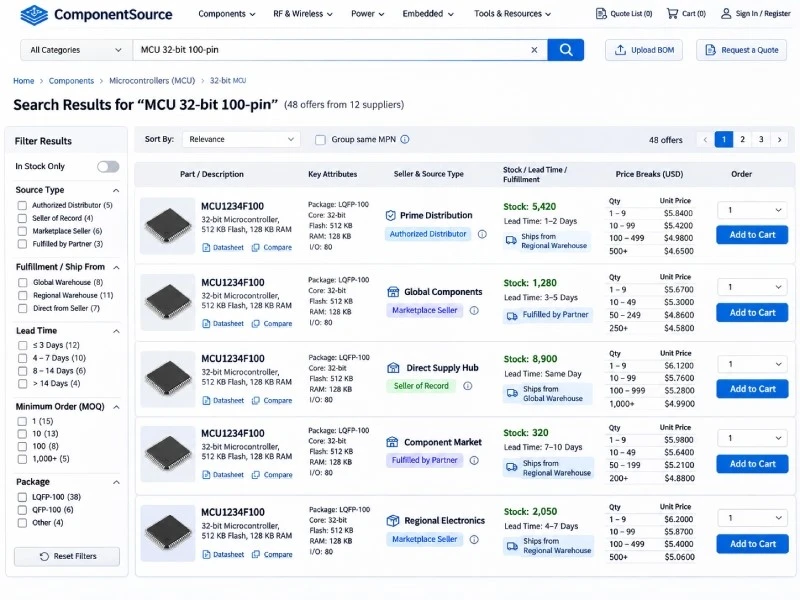
A Familiar Electronics Website May Contain Several Supply Arrangements
Marketplace purchasing can make this more complicated.
Some established component distributors also host third-party inventory offers. A buyer may recognize the website but not realize that a particular listing involves a separate supplier or fulfillment arrangement.
That doesn't mean the third party is necessarily the legal seller. Some marketplace models retain the platform as seller of record while another company supplies or ships the material.
The contractual and supply arrangements need to be understood together.
For an OEM that restricts sourcing to OCM-authorized channels, a familiar website logo isn't enough to settle the question.
The buyer needs to know whether the actual supply route meets the applicable restriction.
The same applies to component inventory aggregators. Finding stock through a recognized search tool doesn't establish which company will ultimately supply it.
This is one reason a source-controlled BOM should be reviewed before purchasing commits to an available offer, rather than assuming the first matching stock listing is acceptable.
Can the Purchase Be Connected to the Material Received?
Once the permitted source and actual seller are understood, the review turns to the physical material.
A purchase order or order confirmation helps establish what was ordered and from whom. An invoice supports the commercial transaction. Delivery and receiving records help show what arrived against that purchase.
A Certificate of Conformance (CoC) can add relevant information, depending on its issuer and the statements it contains.
These records work together. They aren't interchangeable.
A distributor-issued CoC may declare conformity to specified requirements or describe the basis on which the material was supplied. That doesn't automatically make it an original manufacturer certificate.
Nor does a CoC, by itself, prove every upstream transaction or guarantee the authenticity of every device in a shipment.
The useful question is what the document establishes about the actual material under review.
Some CoCs identify an order or shipment. Others include the MPN, quantity, lot, or date-code information. The required content depends on the applicable purchasing and documentation terms.
A certificate shouldn't be rejected simply because it doesn't repeat every identifier found elsewhere, provided the necessary connection can be established through suitable associated records.
But a generic certificate with no credible relationship to the received material contributes little to a specific source review.
The reel label has similar limits.
It can help identify the manufacturer, MPN, packaging, and relevant lot information. It does not independently establish where the EMS provider bought the parts.
The Difficult Case Is Often Stock Already in the Warehouse
Freshly purchased material may have a straightforward link between the supplier order and the receiving record.
Existing inventory is less straightforward.
An EMS provider may have purchased a full reel for an earlier build, used some components, and kept the balance for another order.
The remaining material might have been transferred to a smaller reel, supplied as cut tape, or assigned a new internal barcode.
None of those actions changes the original purchasing source. They can, however, make that source harder to demonstrate.
If the customer requires source or lot identification, the relevant link to the original receipt should remain available.
A newly printed stock label can reference an existing record. It cannot recreate information that was never captured.
There is a harder situation when identical components purchased through different channels have been combined without retaining the distinctions required by the project.
Even if the parts share the same MPN, the EMS provider may no longer be able to establish which source supplied the material allocated to a particular build.
That is an evidence limitation. It is not, by itself, proof that the components are counterfeit.
It does matter if the OEM's approval was tied to a particular source.
For a new turnkey project with a released BOM, defined quantities, manufacturing requirements, and customer-designated purchasing channels, the OEM can submit the project for sourcing and manufacturing review.
Including source restrictions and any conditions on using existing stock gives the purchasing and manufacturing teams a clearer basis for evaluating the proposed material supply before production commitments are made.
The Source Question May Be Open Even When the Parts Look Fine
A sourcing review doesn't always end in a simple pass or fail.
Sometimes the mismatch is explained. The seller is covered by the original approval, the transaction is supported, and the material can be linked to it.
Sometimes the proposed source may be acceptable, but a legal-entity relationship, historical authorization, or inventory connection hasn't yet been established.
And sometimes the evidence clearly shows that the EMS provider bought the material outside the agreed restriction.
Those situations call for different next steps.
|
Review finding |
Practical consequence |
|
Source compliance confirmed |
The purchasing question can be closed, subject to separate material-acceptance requirements |
|
Source not yet verified |
The missing relationship or evidence must be resolved before use where the project requires source confirmation |
|
Purchase outside the approved scope |
The OEM must authorize an appropriate exception or another material disposition must be agreed |
This distinction prevents a common mistake: treating missing evidence as if it were already proof of an unauthorized or counterfeit purchase.
An unresolved source question is not the same as a confirmed violation.
The reverse is equally important. A component can pass a receiving inspection without establishing that it came through the required purchasing channel.
Source approval and material acceptance are separate controls.
What Happens If the Material Has Already Been Issued?
The timing changes the practical response.
Before purchasing, the OEM can review a proposed source and make a decision without having to deal with material already committed.
After receipt, the components may be in stock, assigned to a kit, or scheduled for SMT placement.
If the source requirement remains unresolved and approval is required before use, the affected material needs an appropriate control to prevent unauthorized consumption.
That may involve an electronic inventory hold, controlled segregation, or another established method.
The restriction should follow the affected material, not automatically stop unrelated work.
If components from the disputed purchase have already been assembled, the review needs to establish the relevant affected quantities or production scope.
There is no basis for calling the material counterfeit solely because the seller was not on the approved list.
Whether additional inspection, testing, or investigation is appropriate depends on the actual component and source risk.
An electrical test cannot change who sold the device.
A Customer Exception Needs a Defined Scope
An approved distributor may run out of stock. Another supplier may have the required MPN available.
The EMS team can propose that source, but availability alone doesn't extend its purchasing authority.
If customer approval is required, the proposed exception should be evaluated before the order is placed wherever practical.
The OEM may accept the source, request additional evidence, choose another procurement route, or revise the material plan.
Once the material has been purchased, the options are narrower. A later customer approval may authorize acceptance of the specific exception, but it does not change the actual purchasing history.
The approval needs to say what it covers.
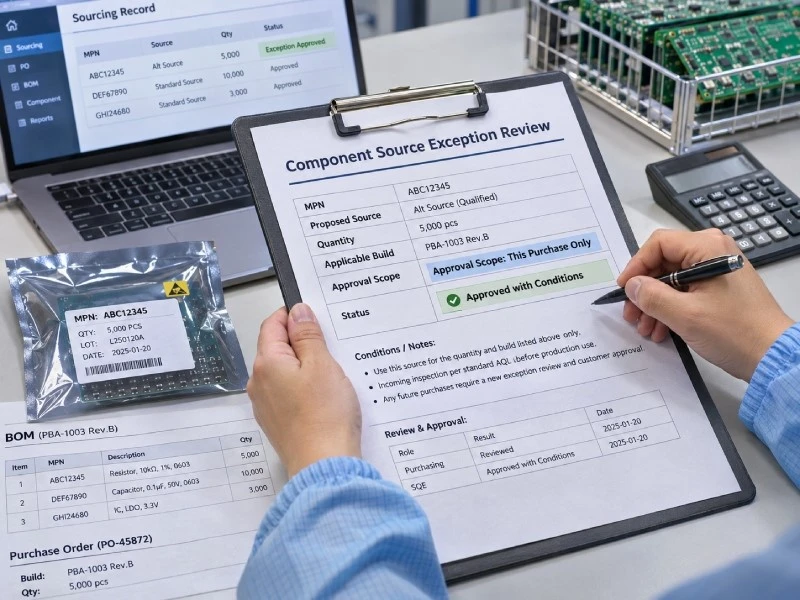
That might be one transaction, a specified quantity, a material lot, a pilot build, or a defined period. A standing approval may also permit subsequent purchases within agreed limits.
A concession for one order shouldn't quietly become permission for every repeat order.
On the other hand, there is no need to demand a new approval for each purchase if an existing authorization clearly covers it.
The applicable customer requirements and the actual approval determine the boundary.
A customer may also accept an independent sourcing channel while requiring additional evidence or material checks. Acceptance of the channel doesn't establish that the components are genuine, properly stored, or suitable for every intended application.
Nor is there a universal requirement to perform X-ray inspection or laboratory testing whenever the source changes.
Those controls need to address identified risks.
For projects where the division of purchasing responsibility, approval authority, and exception handling needs to be formalized, these issues can be considered alongside the PCBA supplier quality agreement.
The agreement should reflect the real project obligations rather than impose a generic approval procedure on every build.
How Much of the Supplier's Purchasing File Does the OEM Need?
Source transparency has a practical commercial boundary.
An EMS provider may have confidential supplier pricing, negotiated discounts, and purchasing arrangements unrelated to the customer's project.
The OEM doesn't necessarily need those details to determine whether a controlled component came through an approved source.
It does need enough evidence to support the source claim.
Depending on the agreement, that may involve relevant transaction records, redacted documentation, supplier confirmations, receiving information, or an agreed audit arrangement.
A supplier can reasonably protect unrelated prices. But a document that conceals the actual source while asking the customer to verify that source isn't much help unless another reliable method has been agreed.
The level of evidence should match the purchasing restriction and the material risk.
A source-controlled semiconductor in a high-reliability product may call for more detailed support than a routine passive component purchased under an unrestricted sourcing arrangement.
The same principle applies when assessing the EMS provider's controls.
A written purchasing policy tells the OEM how the supplier intends to manage sourcing. A relevant transaction or approved exception record can demonstrate how those rules applied to actual material.
Both are useful, but they answer different questions.
The objective isn't unrestricted access to the supplier's purchasing system. It's a source-compliance conclusion that the available evidence can defend.
The Last Check Belongs Before Production, Not After a Complaint
A sourcing requirement only works when it reaches the people placing orders.
The released BOM may identify the correct MPN. A customer purchasing note may restrict the distributors. An earlier email may contain an exception that applies only to a pilot build.
If those instructions aren't available together when the purchase is made, the sourcing team can follow the BOM and still make a decision the customer didn't authorize.
Not every component needs the same level of control, and not every routine purchase needs a customer signature.
The project does need a clear distinction between sources the EMS provider can select within its authority and exceptions the OEM has reserved for approval.
By the time parts are assigned to an assembly order, that distinction should still be supported by the purchasing and material records.
The final question isn't whether the supplier can produce an impressive file of certificates.
It's whether the parts intended for this build can be tied to a purchase the OEM permitted.
If they can, the sourcing question can be closed on that basis.
If they can't, the missing evidence or authorization still needs to be resolved. A matching MPN and a familiar distributor name won't settle it.


