


Overview
PCBA manufacturing changes may require buyer notification when they affect customer-approved production conditions or trigger an agreed notification requirement. Changes to controlled processes, inspection criteria, or manufacturing locations may also require prior approval. Routine adjustments within approved limits can often remain under the EMS supplier's internal controls. The decision depends on the project's agreed requirements and the actual impact of the change.
The Drawing Didn't Change. The Build Conditions Might Have.
Not every manufacturing change needs to be reported to the OEM. Routine adjustments within an approved process may be handled by the EMS supplier, while changes to customer-controlled production conditions, inspection requirements, or other agreed obligations may require advance notice or written approval.
The distinction is particularly important in repeat PCBA production. The next batch may use the same BOM and PCB revision as the previous order, yet be built with different tooling, soldering conditions, or inspection methods.
What matters is whether the supplier is still working within the manufacturing scope the customer accepted-and whether the proposed change falls within the supplier's authority to make.
An unchanged PCB revision is reassuring, but it doesn't tell the whole manufacturing story.
The approved BOM, fabrication data, and assembly drawings define the product. They may also reference certain manufacturing requirements. They don't necessarily identify every machine, process setting, or production arrangement used to assemble it.
A factory needs some flexibility. Equipment is maintained and replaced, production is moved between available lines, and process settings are adjusted to keep operations under control. Most of this is ordinary manufacturing work.
The question arises when an adjustment moves beyond the conditions established for the project.
For repeat PCB assembly orders, the customer and supplier should be clear about what was actually approved. Was production restricted to a named facility? Was a particular process qualified? Did the customer specify inspection coverage, test limits, or traceability requirements?
If those conditions were part of the approval, the supplier cannot rely on an unchanged board revision as permission to alter them.
Equally, the buyer shouldn't assume that approving a product gives them control over every routine adjustment on the factory floor.
The boundary comes from the agreed manufacturing requirements, not from the mere fact that something has changed.
Follow the Change Through the Manufacturing Process
On the production floor, changes are often described in shorthand: a new stencil, a different oven, another SMT line.
Those labels are useful for planning. They aren't enough to decide whether customer notification is required.
The detail lies in what the change does to the established process.
A New Stencil Supplier Doesn't Necessarily Mean a New Printing Process
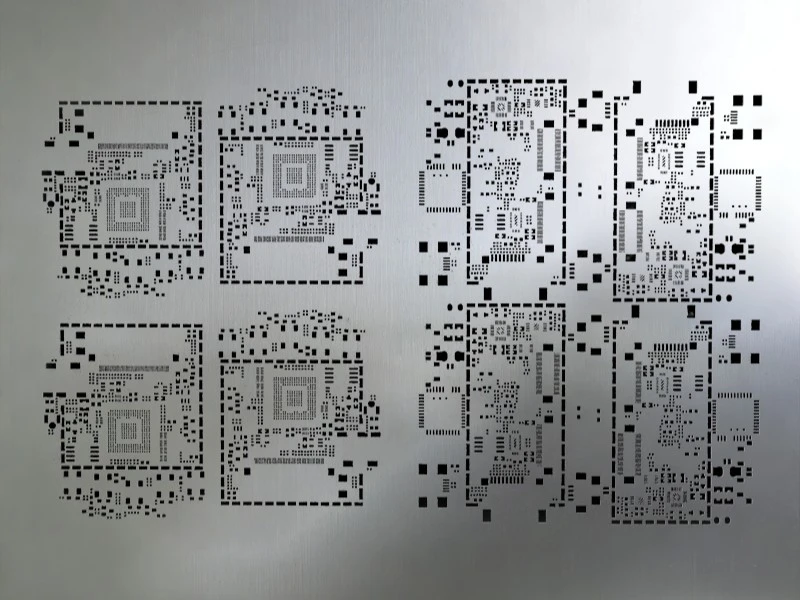
An SMT stencil can be replaced without changing the board design or the approved printing requirements.
If the replacement meets the established specifications for material, thickness, apertures, and other relevant characteristics, the supplier may be able to manage the replacement through normal tooling controls.
Now consider a different change: the aperture design is revised to alter solder paste deposition.
That deserves a closer engineering look.
Changes in paste volume or print consistency can affect solder joint formation, particularly around fine-pitch components and other demanding footprints.
The review may involve checking the stencil dimensions, examining solder paste inspection (SPI) results, and confirming that the printing process continues to meet its established requirements.
An SPI report can help demonstrate how paste was deposited. It does not, on its own, establish the reliability of every downstream solder joint.
The notification decision depends on whether the tooling modification affects an approved process condition or falls within a customer-defined notification requirement.
Simply changing the stencil fabricator is not the same as changing the stencil design.

Same Reflow Oven, Different Process Conditions
Equipment identity can be misleading.
An existing reflow oven may be used with a revised temperature profile. Whether that is a routine adjustment or a more substantial process change depends on the established operating limits and the materials being soldered.
Profile adjustments within a validated process window may be handled through normal process control.
A different solder paste formulation, a new soldering method, or thermal conditions outside the established limits call for further evaluation.
The review needs to consider the actual board and component requirements, the soldering materials, the measured thermal profile, and the evidence supporting the resulting solder joints.
A visually acceptable assembly is encouraging. It is not sufficient evidence, by itself, that a substantially changed soldering process has been validated.
The reverse is worth remembering, too. A reflow oven replacement does not automatically invalidate the existing process. If the replacement equipment is appropriately qualified and can operate within the required conditions, it may remain within the approved manufacturing scope.
The machine changed. The approved process may not have.
Moving Between SMT Lines Is Not the Same as Moving Factories
Moving a build from one SMT line to another within the same facility may be routine, provided the customer-approved scope permits it and the receiving line has the necessary process capability.
Before running the job, the manufacturing team still needs to check the relevant machine programs, tooling, setup, and process controls.
Moving the work to a different facility raises broader questions.
The equipment may differ. So may the operators, supporting processes, environmental controls, work instructions, and inspection arrangements.
That doesn't make the receiving site unsuitable. It means the supplier must establish whether the original manufacturing approval covers the new location and what verification is needed.
Where the customer has approved a specific manufacturing site, the transfer may require advance notification or formal authorization.
The same issue can arise when an approved outsourced operation is moved to a different provider.
In both situations, what matters is the scope of the original approval and whether the revised arrangement satisfies the applicable requirements.

Sometimes the Board Is Unchanged, but the Inspection Isn't
A manufacturing change doesn't always leave visible evidence on the finished PCBA.
It may instead affect how the supplier decides whether a board passes inspection.
Take an automated optical inspection (AOI) program update.
An engineer might adjust the program to reduce false calls or improve detection performance. That can be a legitimate process improvement.
But fewer false calls do not automatically mean the inspection is better.
The revised program should still detect the defects it is expected to detect. Depending on the inspection method and product requirements, that may involve reviewing the inspection settings, coverage, representative test samples, and the treatment of known defect conditions.
If the update preserves the agreed inspection scope and acceptance criteria, it may fall within normal internal controls.
Removing customer-required inspection coverage or changing approved acceptance limits is a different matter.
The buyer may need to review the change because the evidence supporting product acceptance has changed.
STHL's AOI Inspection in SMT Assembly video offers a closer look at automated inspection on a PCB assembly line. It illustrates the inspection process, although qualifying a revised AOI program requires its own verification.
Functional testing follows much the same distinction.
Replacing a test instrument with a properly calibrated and verified equivalent may be routine. Changing agreed pass/fail limits or removing a required test operation can affect the customer's acceptance basis.
First-article inspection (FAI) has a role here, but its limits matter. It can help confirm component identity, placement, polarity, and relevant aspects of assembly setup. It cannot independently qualify a new soldering material, establish equivalent test coverage, or validate an entire factory transfer.
The evidence has to address the process that actually changed.
Traceability is another area where the physical product can remain unchanged.
A supplier might migrate production records to a new manufacturing execution system (MES), revise lot-identification rules, or change how inspection results are stored.
If the new arrangement preserves the required records and their relationship to the manufactured assemblies, the change may be managed internally.
If that relationship is weakened or customer-required information is lost, the buyer has a legitimate reason to be involved.
For OEM engineering and supplier quality teams reviewing an actual change to inspection requirements, manufacturing records, or production documentation, the relevant specifications and proposed changes can be shared with Shenzhen STHL Technology Co., Ltd. (STHL) at info@pcba-china.com for an initial technical discussion.
The useful starting point is the requirement being affected, not simply a request for another inspection report.
Notification Is Not the Same as Permission
A supplier can have good technical reasons for a change and still need the customer's authorization.
Conversely, the supplier's quality system may permit certain adjustments without individual customer involvement.
The governing conditions may be documented in a supplier quality agreement, customer specification, approved manufacturing plan, purchase order, or another project-specific arrangement.
Three different outcomes are possible.
Internal control
The adjustment remains within the approved manufacturing scope and does not trigger a customer notification obligation. Appropriate internal review, verification, authorization, and records are still necessary.
Buyer notification
The change falls within an agreed notification category. The supplier provides the required information and follows the applicable notice and review conditions. Separate approval may not be required.
Prior buyer approval
The proposed change affects a condition reserved for customer authorization, or the agreement explicitly requires approval. The supplier must obtain that authorization before applying the change to the affected production.
The same type of change can fall into different categories for different customers.
For one PCB assembly program, moving between qualified SMT lines may be permitted without additional notification. Another customer may have restricted production to a particular line or manufacturing arrangement.
Technical risk and contractual authority both matter. Neither can be ignored.
The distinction also prevents different change-control processes from becoming tangled.
A component manufacturer's Product Change Notification (PCN) concerns a change originating from the component manufacturer. An EMS manufacturing change concerns the supplier's own production or inspection arrangements.
Similarly, a manufacturing-process adjustment does not automatically require an OEM engineering change order (ECO). That depends on whether the released design or other customer-controlled requirements are being changed.
Keeping those responsibilities separate makes it easier to determine who needs to review the proposal.
A Useful Change Notice Should Survive a Production Audit
A message announcing a new machine or a process improvement is not necessarily a useful change notice.
The buyer needs to know what the previous arrangement was, what will replace it, and why the supplier believes the revised conditions are acceptable.
The notice should identify the products or operations involved, describe the potential impact, and make clear what supporting verification has been completed.
For a placement machine replacement, that evidence might include setup verification, placement checks, and appropriate first-article results.
For a revised reflow process, the review may need information about soldering materials, thermal conditions, process limits, and solder joint verification.
For an inspection-program change, the relevant question is whether the required defect coverage and acceptance criteria remain satisfied.
Not every adjustment calls for an extensive qualification package. The evidence should fit the change-not simply fill a standard set of attachments.
Then comes a detail that can be missed even after the technical decision is made: which boards will actually be built under the revised conditions?
An approval date is not necessarily a production cut-in point.
Boards may already be in work in progress (WIP). Some could have passed through the operation being changed, while others are still waiting for it.
If an existing production lot spans the transition, recording only the lot number may not be enough to distinguish the two manufacturing conditions.
Depending on the agreed traceability requirements, the supplier may need to separate the affected work or identify the change by production order, sub-lot, serial-number range, operation record, or another controlled reference.
Any affected WIP also needs an appropriate disposition.
This is where change records become useful in a later investigation. If a defect pattern appears after the adjustment, the buyer and supplier should be able to determine which assemblies were produced before and after the change.
A signed approval is of limited help if the affected production cannot be identified.
The notice should also say whether the buyer is being informed, asked to review the technical evidence, or asked to provide written authorization.
Those are different requests, with different consequences.
For a new PCB assembly program or an upcoming repeat build, OEM teams can submit their PCBA project requirements, including available engineering files, expected quantities, and any customer-specific manufacturing or change-approval conditions that need to be considered.
Agreeing on those conditions during project preparation is more useful than trying to establish them after a disputed change.
When the Approved Process Is No Longer Available
Not every production disruption arrives with enough warning for an orderly change request.
A machine can fail. A required operation can become unavailable. Production may need to stop while an alternative is assessed.
That urgency does not automatically give the supplier permission to use an unapproved process.
If the proposed alternative affects a customer-controlled condition, the affected work may need to remain on hold until the necessary authorization is obtained.
An expedited review or a temporary deviation may be appropriate, depending on the project requirements.
A temporary deviation needs a defined scope. It should identify the affected product or production, the conditions under which the alternative is permitted, and when the authorization ends.

It should not quietly turn into a permanent process change.
Already affected WIP may need containment, additional inspection, or another agreed disposition.
There is a related distinction between a planned manufacturing change and a quality escape. If nonconforming product has already been built or shipped, separate containment, customer escalation, and corrective-action requirements may apply.
That situation is not simply a planned change awaiting retrospective approval.
Nor should the supplier interpret a lack of response as permission to proceed.
Some agreements expressly allow defined changes to take effect after a notification period without objection. Others require affirmative written approval. The applicable terms govern.
When approval is required, a sent email is not an approved change.
Make the Boundary Clear Before the Next Repeat Build
The most workable change-notification arrangements leave room for normal factory operations without giving the supplier unlimited discretion over customer-controlled conditions.
For repeat PCBA programs, the buyer and EMS supplier should establish which manufacturing locations, processes, inspection or test requirements, and traceability obligations are specifically controlled.
They should also agree on notification triggers, approval authority, supporting evidence, and any applicable notice periods.
A purchasing contact may coordinate the request, while engineering or supplier quality may be responsible for the technical decision.
There is no universal notification deadline suitable for every PCBA manufacturing change. The requirements depend on the project and the obligations accepted by the supplier.
A factory should be able to maintain equipment and improve its processes without turning every routine adjustment into an approval exercise.
The customer, meanwhile, should not have to discover an unauthorized process change during a field-return investigation.
A clear boundary makes both possible. When something changes, the records should establish what was different, whether the change was authorized, and which assemblies were actually affected.


