


Low-volume PCBA for automation equipment is not simply mass production with a smaller lot size.
That misunderstanding causes real trouble in sourcing. A buyer may send Gerber files, a BOM, and a target quantity of 20, 50, or 200 units, then expect the supplier to treat the job as a straightforward small-batch PCB Assembly order.
For automation equipment, the question is different.
In low-volume PCBA for automation equipment, the main change is that assembly, testing, and validation must prove repeatability. The board has to be built, programmed, tested, documented, and integrated in a way that can be repeated after the first lot.
The board count may be small. The number of unresolved details can still be high.
Low-Volume Automation PCBA Sits Between Prototype Learning and Production Discipline
In many automation equipment projects, low-volume PCBA appears after the prototype has already worked on the bench.
The schematic is mostly stable. The PCB layout has been reviewed. The first samples may have powered up. The customer may have already tested one or two boards inside a machine, fixture, cabinet, controller, gateway, or trial system.
But that does not always mean the project is production-ready.
A prototype can succeed because one engineer knows every jumper, every firmware step, every workaround, and every test condition. A low-volume build has to remove that dependency. It needs a process the EMS team can repeat and a validation method that does not rely on undocumented engineering knowledge.
This is where automation projects often slow down.
The constraint is not always SMT line capacity. Often, the real schedule driver is one unresolved item: a connector definition, a firmware file, a test fixture, an approved alternate, a panelization detail, or an enclosure constraint that was not confirmed before release.
In small-batch automation PCBA, the slowest unresolved detail often controls the build more than the fastest machine.
The Cost Structure Changes Because Fixed Setup Work Does Not Disappear
Low-volume buyers sometimes compare quotations as if the only difference is unit count. That is rarely true.
Non-recurring engineering (NRE) costs - such as stencil preparation, machine programming, fixture planning, functional test setup, and first-article review - do not disappear just because the lot is small.
In high-volume production, these costs are spread across many units. In low-volume work, they sit much closer to the surface.
That does not mean a supplier is overcharging because the batch is small. It means the buyer should separate one-time setup costs from recurring per-unit costs when reviewing a quotation.
This is especially important for automation equipment because the validation scope may be more specific than a general PCBA build. If a fixture is needed to simulate inputs, switch relays, load firmware, or verify communication, that fixture is not just an accessory. It is part of how the batch is released.
A practical RFQ should make the cost structure visible:
- What is one-time setup or NRE?
- What is recurring assembly cost?
- What is material cost?
- What is inspection cost?
- What is functional test cost?
- Is fixture preparation included or separate?
- Are test records, labels, or traceability reports included?
Without that separation, two quotations may look different because they cover different scopes, not because one supplier is more efficient.
Assembly Changes Because Automation Boards Are Rarely Simple SMT Boards
Many automation equipment PCBAs are not pure SMT assemblies.
They may include terminal blocks, relays, transformers, power connectors, headers, fuses, large capacitors, optocouplers, industrial communication ports, cable connectors, and mounting hardware. Some boards may also need manual through-hole insertion, selective soldering, wave soldering, or post-assembly mechanical checks.
That makes the assembly route more important than the quantity suggests.
For a consumer device board, a low-volume build may mainly involve SMT PCB Assembly, automated optical inspection (AOI), and a basic functional check. For an automation control board, the EMS partner may need to consider:
- SMT placement and reflow profile
- through-hole component insertion
- terminal block or connector alignment
- relay and power component handling
- selective soldering or wave soldering
- fixture access after assembly
- cable or harness connection points
- clearance around high-profile components
- labeling and traceability requirements
The process route matters because low-volume PCBA is often the first time the board is assembled in a way that resembles future production.
A hand-built prototype can hide process problems. A low-volume PCBA batch starts to reveal them.

New Product Introduction and First Article Inspection Carry More Weight
High-volume production creates a lot of process data over time. A low-volume automation build does not.
If the batch is only dozens or a few hundred boards, there may not be enough production data to reveal a trend before the order is already complete. That makes the early production gate more important.
This is where new product introduction (NPI) and first article inspection (FAI) matter.
For low-volume automation PCBA, FAI should not be treated as paperwork after production. It should be treated as a production gate that confirms whether the build can proceed under the intended process.
A useful first-article review may check:
- component placement against the BOM
- polarity and orientation
- solder quality on critical components
- connector alignment
- through-hole soldering quality
- reflow or soldering process records where required
- firmware programming method
- functional test result
- label or serial number format
- any special mechanical or fixture-related requirement
The first article does not need to be overcomplicated for every project. A simple board should not be buried under unnecessary reporting.
But FAI should answer one question clearly:
Can the rest of the batch be built under the same assumptions?
If production continues while first-article questions are still open, the value of FAI is weakened.
Validation Changes Because the Board Must Prove Equipment Behavior
For automation equipment, "the board powers on" is rarely enough.
A PCBA may need to switch a relay, read an input, drive an output, communicate with a controller, accept firmware, respond to a sensor signal, or connect to a machine-level test environment. Some functions only make sense when the board is connected to cables, fixtures, loads, or software.
This is why validation should be defined before the build starts.
A useful validation plan should answer practical questions:
- What function must the board prove before shipment?
- Does the EMS partner need firmware, test software, or programming instructions?
- Is there a test fixture, or will one need to be prepared?
- Are connector or pogo pin access points available?
- What is the expected output behavior?
- What is the pass/fail standard?
- What should happen after rework?
- Are test results recorded by serial number or batch?
A test that only one engineer can run is not yet a production test.
For low-volume PCBA, the goal is not always to build a full production in-circuit test (ICT) or functional test (FCT) system immediately. The right level depends on the project. But the test must be clear enough that the EMS team can repeat it without guessing.
That is the difference between a working sample and a validated small-batch build.
Inspection Should Follow Risk, Not Board Count
Low quantity does not automatically mean low risk.
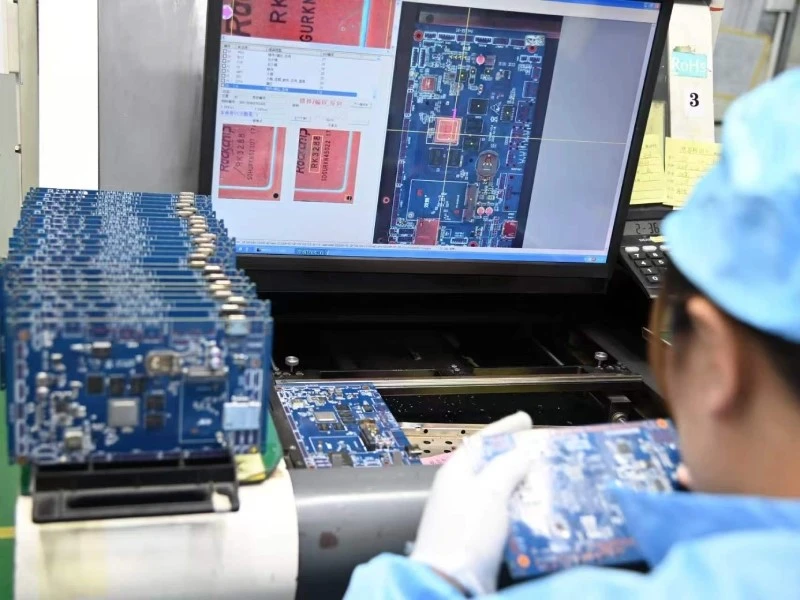
Some automation boards can be inspected with standard AOI and basic electrical confirmation. Others may need X-ray inspection for BGA or QFN packages, ICT for circuit-level checks, FCT for product-specific functions, or additional visual inspection around connectors and through-hole joints.
The decision should follow the board's function, package type, field role, and failure impact.
A simple interface board with visible solder joints, no firmware, and no critical control function may not need a heavy validation package. A control board with firmware, relays, I/O, communication ports, power sections, hidden solder joints, or field-service impact may need a more structured testing and inspection plan.
An AOI-only build and a fixture-based FCT build are not the same project, even if the board count is identical.
That distinction should appear in the quotation. Otherwise, the buyer may compare two prices that do not cover the same scope.
BOM Control Becomes More Important, Not Less
Some buyers assume BOM control matters mainly in high-volume production. In automation equipment, it often matters earlier.
A low-volume PCBA batch may use specialized ICs, industrial connectors, relays, power devices, isolated interface components, communication modules, or customer-specified parts. If one of those items is unclear, unavailable, or substituted informally, the batch may still be assembled, but repeatability becomes weaker.
This is especially important for machine builders and automation equipment OEMs.
A replacement connector may fit the footprint but change field wiring behavior. A relay may match the package but not the load condition. A communication IC may be available through one channel today but difficult to source again for the next batch. A power component may be electrically close but not equivalent in thermal behavior.
In low-volume work, the buyer and EMS partner should define approved manufacturer part numbers, approved alternates, critical parts, long-lead items, and substitution rules early.
This is where component sourcing is not only about purchasing parts. It becomes part of validation discipline.
If the first lot uses one version of the BOM and the second lot quietly uses another, the buyer may not know whether a later performance issue came from the design, the process, the firmware, or the material change.
HMLV Capability Matters More Than Factory Size
A large SMT factory is not automatically the best fit for low-volume automation PCBA.
High-volume lines are usually designed for stable, repetitive production. Low-volume automation work is often high-mix, low-volume (HMLV) work: multiple board types, smaller lots, repeat orders separated by weeks or months, and design changes that still need discipline.
The useful question is not only, "How many boards can this factory build per day?"
A better question is:
Can the EMS partner keep process consistency when the same automation board is built again later?
That means the supplier should be able to manage stored process parameters, reflow profiles, inspection programs, test instructions, BOM revision records, and work instructions for repeat builds.
For automation equipment, repeatability is not only about producing many units at once. It is also about producing the next small batch under the same controlled assumptions.
A supplier whose operation is built only for high-volume throughput may treat small batches as interruptions. A supplier with HMLV discipline treats them as a normal manufacturing model.
Mechanical and Integration Details Arrive Earlier in Automation Projects
Automation equipment PCBA often does not stay as a loose board for long.
The board may need to fit into a module housing, control cabinet, embedded controller, industrial PC chassis, gateway enclosure, machine panel, or test fixture. Even when the order is only for board-level assembly, mechanical details can influence the PCBA process.
Connector direction matters.
Cable bend radius matters.
Mounting holes matter.
Label position matters.
Test point access matters.
Grounding or chassis connection points may matter.
A board that passes electrical validation can still create integration trouble if the cable cannot be installed cleanly, the connector is blocked by the enclosure, or the label becomes unreadable after assembly.
For this reason, low-volume automation PCBA should often include an early check for box build or integration readiness. The buyer may not need full box build assembly yet, but the PCBA should not be planned as if mechanical integration will never happen.
A small enclosure conflict in the first 20 boards is annoying. The same conflict in repeat production becomes a process problem.

Documentation Should Be Right-Sized, Not Ignored
Low-volume automation projects do not always need a heavy documentation package. But they do need enough records to support repeat builds.
At minimum, the buyer and EMS partner should agree on what needs to be tracked:
- PCB revision
- BOM revision
- firmware version
- approved alternates
- test method
- test result format
- serial number or batch label
- rework and retest rules
- packaging or shipment batch information
The right level depends on the application.
A lab-use automation fixture may need a lighter record set. A controller used inside field equipment may require stricter revision and test traceability.
The mistake is not choosing a simple documentation package.
The mistake is leaving documentation undefined.
When low-volume PCBA becomes repeat business, unclear records become expensive to reconstruct.
Industry Signal: Automation Is Becoming More Configurable
Automation equipment is becoming more configurable. Machine builders and industrial OEMs often need smaller batches, more variants, faster iteration, and more software-defined functions than traditional stable high-volume electronics programs.
That does not mean every low-volume PCBA project needs a heavy validation framework. It does mean buyers should pay closer attention to assembly repeatability, component sourcing stability, firmware control, and test readiness.
For automation equipment, flexibility is useful only when it does not break repeatability.
That is why low-volume automation PCBA should be planned as a controlled production event, not just a larger prototype order.
What OEM Buyers Should Prepare Before RFQ
Before sending a low-volume automation PCBA project for quotation, buyers should prepare more than Gerber files and a BOM.
A useful package may include:
- Gerber or ODB++ files
- BOM with manufacturer part numbers
- PCB revision and BOM revision
- assembly drawing
- pick-and-place file
- polarity and orientation notes
- approved alternates or substitution rules
- firmware file or programming requirement
- expected functional behavior
- FCT or validation procedure if available
- connector, cable, or enclosure notes
- test point access requirements
- coating, cleaning, or protection requirements where needed
- labeling, serial number, or traceability expectations
- packaging requirements
This does not mean every project needs every file from day one.
But unclear inputs create unclear quotes. In low-volume automation PCBA, unclear quotes usually turn into extra questions, delayed validation, or assumptions entering the build.
What Changes from Prototype to Low-Volume Automation PCBA
|
Area |
Prototype Build |
Low-Volume Automation PCBA |
|
Main goal |
Prove the design can work |
Prove the build can be repeated |
|
Assembly method |
May rely on manual adjustment |
Needs a defined process route |
|
NRE / setup cost |
Often kept light |
Should be separated from unit cost |
|
NPI / FAI |
May be informal |
Should act as a production gate |
|
BOM control |
May tolerate temporary sourcing |
Needs approved parts and alternates |
|
Testing |
Often engineer-driven |
Should be repeatable by production staff |
|
Firmware |
May be handled manually |
Needs version control and programming steps |
|
Inspection |
May focus on obvious defects |
Should match package, connector, and function risk |
|
Mechanical fit |
Often checked late |
Should be considered before release |
|
Documentation |
Light or informal |
Right-sized records for repeat builds |
This is the practical line between a sample and a low-volume production-ready build.
The board count may still be small. The process expectation is different.
Where STHL Fits in This Discussion
For OEM buyers preparing automation equipment projects, Shenzhen STHL Technology Co., Ltd. can review low-volume PCBA requirements from a PCB Assembly perspective and help identify what needs to be clarified before assembly, testing, and validation.
That may include component sourcing review, SMT and through-hole process planning, connector handling, FCT preparation, firmware programming inputs, traceability records, or box build readiness.
The goal is not to overbuild every small-batch order. A simple board should stay simple.
The goal is to prevent a low-volume automation PCBA build from depending on assumptions that cannot be repeated.
Conclusion
Low-volume PCBA for automation equipment changes the manufacturing conversation.
The quantity may be small, but the build still needs controlled sourcing, a stable assembly route, NPI discipline, practical validation, firmware readiness, connector and mechanical awareness, and enough documentation to support repeat orders.
For OEM buyers, the important question is not only, "Can this supplier assemble 50 boards?"
The better question is: "Can this supplier help us turn this automation PCBA into a build that can be assembled, tested, integrated, and repeated without relying on guesswork?"
Need a low-volume PCBA or automation equipment PCB Assembly quotation? Submit your files through Request a Quote or contact STHL directly at info@pcba-china.com


